
Answer engine optimization (AEO): what actually works, and what nobody has proven yet
AEO is mostly ordinary SEO with the answer made easy to lift. Here is the short list the evidence supports, the parts still unproven, and what we saw on a client’s own pages.
Someone has probably told you your business needs answer engine optimization, or AEO, so that ChatGPT and Google’s AI answers name you instead of a competitor. I went through those claims one at a time against Google’s own documentation and the peer-reviewed research, because I sell this work and I need to know which parts I can defend in a room. Some of it holds. The tactic sold hardest of all turns out to be one Google has explicitly ruled out. If you are a step earlier than this and still weighing whether AI search is worth doing anything about, start there.
What is answer engine optimization (AEO)?
Answer engine optimization, or AEO, is making your page the clean, correct, self-contained answer to a real question, so an answer engine like ChatGPT, Perplexity, or Google’s AI Overviews can lift it and credit you. Generative engine optimization (GEO) and “AI SEO” are the same idea under different names.
The names multiplied faster than the practice did. Strip the labels away and the job is old: be the most useful, most trustworthy answer to a question a real person is asking. What changed is who reads it first. A model now sits between your page and your buyer. It reads on their behalf and decides who gets quoted.
Is AEO different from SEO?
SEO supplies important foundations, but engines have different retrieval systems. Google requires ordinary search index and snippet eligibility for AI Overviews and AI Mode. Other engines have their own search access and source-selection paths.
This is the part the packages tend to skip, because it is harder to sell. Google’s own documentation is explicit that its AI features draw from the same index that powers normal search, and that a page has to be indexed and eligible to appear in ordinary results before it can show up in an AI Overview at all. If Google cannot retrieve your page, no amount of AEO styling puts you in the answer. The foundation is still technical SEO: a page an engine can crawl, read, and index.
Do I need special code, schema, or an llms.txt file?
No. Google states that structured data is not required for its generative AI features, that there is no special markup that makes a page eligible, and that AI-specific files will neither help nor hurt your visibility.
Schema markup is still worth adding, because it helps human search results and keeps your facts machine-readable. But it is not an AEO cheat code, and anyone selling you a schema package as the way into AI search is selling you something Google has already said does not work that way. The same goes for the “add this file and ChatGPT will cite you” advice. It is not how retrieval works.
What actually makes an AI cite your page?
Whether your page is genuinely the relevant answer, and whether it was among the sources the system already retrieved. A factorial experiment across six models and 252,000 trials found relevance and retrieval position are the primary determinants of the first citation.
The model can only quote from the handful of pages it pulled to answer the question, and within that set it favours whichever one most directly answers what was asked. Ordinary retrieval settles both of those before a single writing tactic comes into play, which is why the last-mile advice matters only once you are already in the set.
Does the way you write change anything?
Yes, but only once your page is already in the running. Adding direct quotations, statistics, and cited sources raised relative citation visibility in the lab by 41, 33, and 30 percent in the KDD 2024 experiment. Keyword stuffing was the only tested tactic that backfired, at about minus 8 percent.
This is evidence of an on-page effect in a controlled research setup, and useful factual writing can also make a page better for the human reader. The tactic SEO folklore still leans on, cramming keywords, was the one thing tested that measurably hurt.
| What you add to the page | Change in relative citation visibility in the lab |
|---|---|
| Direct quotations | +41% |
| Statistics | +33% |
| Cited sources | +30% |
| Keyword stuffing | about −8% |
How do you show up in ChatGPT and Google AI Overviews specifically?
For Google AI features, check Google index and snippet eligibility. For ChatGPT search, check OAI-SearchBot access and readable, useful source content. Eligibility is necessary, but it does not guarantee citation or recommendation.
Two practical checks sit under that. First, compare initial HTML and rendered content for important pages. Engines differ in rendering capability; a browser-visible page alone does not establish crawl or index eligibility. Second, confirm you are letting the relevant crawlers in. OpenAI distinguishes OAI-SearchBot for search from GPTBot for training. PerplexityBot supports Perplexity search; Googlebot and ordinary eligibility support Google Search AI features. Google-Extended controls other uses and does not determine Google Search inclusion. Search access and training controls should be reviewed separately, alongside any CDN or firewall restrictions.
Will AEO actually bring you more customers?
A citation does not establish a customer outcome. The 2026 academic survey of the field found no reviewed technique with a stable, cross-platform causal effect on discoverability or on downstream clicks and conversions.
The survey reviewing AEO techniques concludes that commercial claims about generative engine optimization have advanced faster than the evidence for them. The writing tactics move relative citation visibility in the lab in a lab. Whether that turns into traffic, and whether that traffic turns into customers, has not been shown in any way that holds up across engines.
I scope this work around practical discovery gaps and a measurement plan. If a provider quotes a customer uplift, ask for the period, control, channel records and qualification method. Reported revenue, referral visits and citations should each have their own evidence.
So what should you actually do?
Build the page that answers your buyer’s question, make sure engines can reach it, and treat AEO as the last thing you do rather than the first. The boring version is the only one with evidence behind it.
We did the ordinary version of this for JS Wallmatrix, an interior-finishing supplier. We were the first developers to touch the site and the first to set up any measurement on it, so there was no meaningful before. Keyword research told us which pages buyers were already searching for, and we built those. JSW reported 80+ qualified enquiries and approximately 6,500 square metres quoted in its initial five-month period, confirmed July 2026. In the separate February–July sample, eight of 24 page-sourced enquiries came through long-tail variants. The cohorts overlap and page source does not establish acquisition channel.
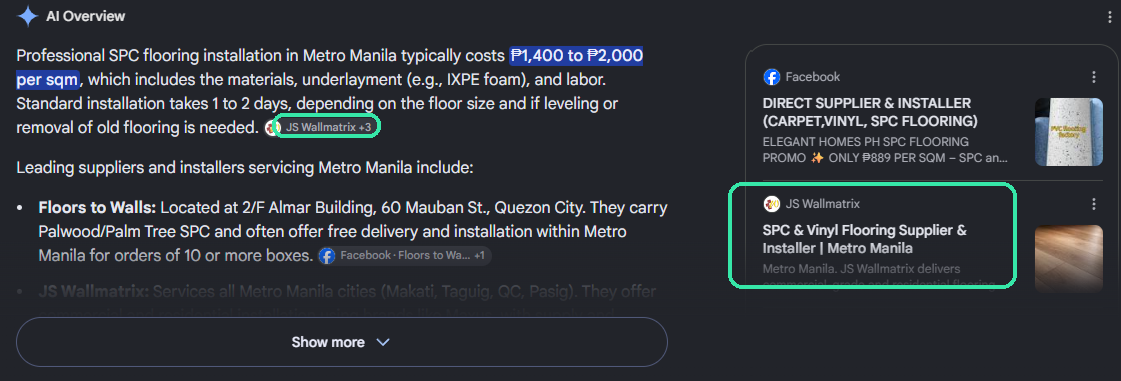
None of that was AEO work. There was no schema package and no llms.txt file. We picked the questions buyers were already typing and answered them properly. Months later I ran a buyer search in their category and Google’s AI Overview came back citing their pages by name. I had not optimised for it and I could not have promised it in advance. That is the shape of this work: you can earn the conditions for a citation, and you cannot order one.
Read JSW’s dated citations and enquiry evidence, or explore Strata’s AI-search optimization service.
Sources
Operator documentation, peer-reviewed research, and a research institution with published methodology. No agency or SEO-tool content is cited here, deliberately.
- 1.Google Search Central, Google’s guide to optimizing for generative AI features on SearchGoogle’s own documentation for AI Overviews and AI Mode.
- 2.Google Search Central, AI features and your websiteEligibility requirements for appearing in Google’s AI features.
- 3.Aggarwal et al., GEO: Generative Engine Optimization, KDD 2024Peer-reviewed, ACM SIGKDD. Controlled experiment across 10,000 queries.
- 4.Optimizing Visibility in Generative Engines: A Critical Survey of Generative Engine Optimization, 2023 to 2026Academic survey grading which findings in the field replicated and which did not.
- 5.Pew Research Center, Google users are less likely to click on links when an AI summary appears, July 2025Measured browsing behaviour of 900 US adults during March 2025.
- 6.OpenAI, crawler and bot documentationOpenAI describing what each of its crawlers does.
- 7.Perplexity, crawler documentationPerplexity describing PerplexityBot and Perplexity-User.